

It happened on the corner of 30th Street and Maple Avenue, a suburban crossroads separating my hometown of Brookfield, Illinois, and our neighboring town, LaGrange Park. I lived one block plus three houses down and one street over from the only potentially perilous intersection on my daily path to school. Sometimes I cut through the grey stone alley that ended behind our backyard, but the rest of the walk was on a grass-lined, concrete sidewalk passing lovely brick bungalows and tri-level homes with seasonal landscaping.
From the dozen or so streets making up this idyllic and lily-white section of North Brookfield, the intersection of 30th and Maple is where we all converged and waited for the traffic light to turn. As cars patiently idled on either side of the crosswalk, we walked through the white lines as a blob of children. Once across, the blob disintegrated into small groups according to age and gender and we all completed the trek to school. Raymond Avenue was three short blocks away, and that’s where the Catholics went to the left, and the Publics went to the right.
I was a first grader at the Catholic school, the one on the left. My brother was in fifth grade and my sister was in eighth, but I don’t remember ever walking to school with them. Perhaps our classes started at different times or perhaps they didn’t want to be seen with their little sister. Nor do I remember why my parents felt their six-year-old didn’t need to be escorted or protected on her way to school. It was 1966, before Stranger Danger education—at least in our seemingly safe-and-sound world. And since none of their older children ever had an incident on their daily walk to school, why would they suspect anything might happen to me?
“By the third kid, you know, you let ’em juggle knives,” claims Mary Steenburgen’s character in the 1989 film Parenthood. Well, I was the fourth. And this very well may have been the day that I earned the “problem child” designation—a little like the fourth child, Larry, also in the movie Parenthood.
It was late November when the trees were bare, the temperatures bitter, and the season of Advent drew near. First-grade Catholic indoctrination includes preparing young hearts and minds for the celebration of the birth of Jesus, and we were putting together an Advent wreath in our classroom. Desperately wanting to contribute, I begged my mother to let me bring to school a set of her glass candlestick holders shaped like stars. I believed they would be perfect for the wreath and that my teacher, Sister Euphrasia, would think highly of me for the contribution.
It was a goal of mine during that challenging school year to get some kind—any kind—of positive feedback from this always-scary creature in the long black habit. It felt like no matter how hard I tried, I couldn’t get on her good side. I don’t know if she just didn’t like any of the little girls—she, like a lot of the nuns, favored the boys—or if it was just me. Little Michele—number four in the brood from Brookfield who wore a too-big plaid jumper uniform without the proper breast patch, and whose unruly red hair was always forced into pigtails.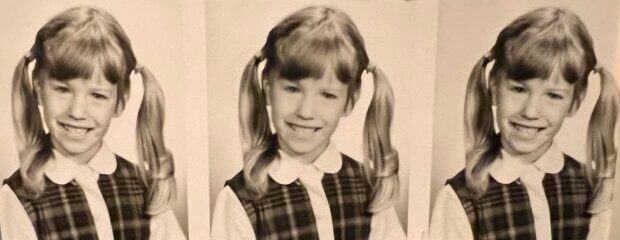
I learned through my ensuing years of parochial schooling that classroom nuns and precocious young girls were a recipe for trauma. But it started with Sr. Euphrasia.
The glass stars were an easy yes for my mom. She was a devout Catholic who often told us how much she loved and revered the nuns who provided her elementary and high school education. She was a prefect at St. Mary’s in Melrose, Mass., and may have even joined the convent had the Great Depression not made it necessary for her to earn an income to help support her family. And when WWII brought my father into her life, she chose the life of a Catholic wife and mother rather than a nun. As she was deeply invested in her children’s Catholic education, I believe she was proud of me for wanting to participate in the creation of my first Advent wreath. So, she taped labels with my name to the bottom of the glass star candlestick holders and put them in a plastic bag. I draped the bag handles around my wrist like a dramatic hanging bracelet and proudly carried my gift for baby Jesus to school. I couldn’t wait to present the glass stars to Sr. Euphrasia.
And then I got to the corner of 30th and Maple.
While waiting at the crosswalk for the light to change, I saw them approaching from the north. They were a group of older boys whose open jackets exposed white shirts and royal blue ties, the Catholic schoolboy uniform. Yet even though they were part of my Tribe, they had the essence of Enemy.
I recognized one. His name was Jimmy and he was my sister’s age. He recognized me, too. When our eyes met, his popped open and then instantly narrowed. I believe he realized I was Debby’s little sister—that he KNEW me—and that gave him some sort of license to be a mean-ass teenage boy. At the tender age of six, I had already faced a lifetime of being teased and relentlessly picked on by older boys, my brother and his neighborhood friends included. Because I had learned to expect the worst behavior from boys, it triggered my fight-or-flight instincts.
“Hey, hey! What do we have here!” Jimmy said with a cackle. “Why it’s a little VanOrt!” And as he reached toward my first-grade ass hiding behind a long blue parka, I planted my feet and braced myself for a fight. He swatted my backside, which was covered by the protective parka and it sounded like popped paper lunch bag. Infuriated, I clutched my plastic bracelet containing the glass stars and swung, striking him right in the temple. I was aiming for his shoulder, but he was bent toward me and took it in the head.
Jimmy immediately drew his hands to his skull, made a U-turn, and ran crying back north on the Maple Avenue sidewalk. One of his buddies laughed and said, “nice shot, kid.” The others stood there with their mouths hanging open and quickly took a step back from me. This was before we had a crossing guard, so I think the eighth-grade boys were the only witnesses to what was reported as a brutal attack by a nasty little VanOrt.
After making our way through the crosswalk, the boys crossed to the other side of the street and kept their eyes on me, speaking in low tones as we made parallel tracks toward Raymond Avenue. I walked with my head down the rest of the way.
I delivered the glass stars to Sr. Euphrasia and quietly sat at my desk. I don’t remember how the candleholders were received. I don’t even remember if they were used for our Advent wreath. What I do remember is later that morning, there was a knock on our classroom door.
This was a year before our nuns got what they called their “mini habits” and Sr. Euphrasia was dressed in a full-on, head-to-toe nun habit, with a big white collar, a black veil with no hair showing, and rosaries and crucifixes hanging all over the place. I had a bad feeling watching Sr. Euphrasia float to the door. As she opened it and stepped into the hall, I caught a glimpse of another nun, a priest, and . . . oh God, Jimmy. My throat went tight.
Moments later, I was called into the meeting. I don’t remember what they said to me or if I even had a chance to defend my action, but I do know that I didn’t have a single advocate and that I was the one in trouble. It mattered to no one that I was the target of harassment. I had assaulted a good Catholic boy for apparently no reason and clearly I was a violent, aggressive child that needed greater discipline. I believe they let me off easy by demanding I apologize to Jimmy. And I truly was sorry that I hurt him. Hell, I didn’t know the kind of damage those glass stars could cause. I was six! I had fought back with the only weapon available to me.
After the reprimand, I reentered the classroom and felt every set of eyes upon me. I burst out crying. I made it to my desk and put my head down, and I very clearly remember Sr. Euphrasia telling my fellow students to ignore me. “She’s a bad girl.”
That was the day I learned about judgment.
Soon, after several days of refusing to go to school, my parents reached an agreement with the administrators to transfer me to a different first-grade class. I had had enough of Sr. Euphrasia. The day I moved, she made me carry all my books and supplies and didn’t open the door for me. When a couple of books fell from my arms she told the students not to help me. “Go on, get out!” she said.
Sr. Agnella, who years later became the principal, and I understood, had held me as a baby, was my new teacher for the rest of the school year. Sr. Agnella was the only nun I ever loved. She taught me what it meant to be fair-minded when it came to the law of obedience inflicted upon all of us guilty little Catholics. And she may have been the only nun who didn’t partake in any convent gossip relating to me. I’ve got stories from second and fourth grades that hold traumatic memories due to the lineup of Sister Mary Elephants I had to face each day during those delicate years.
Regarding the glass stars, ultimately my mother took the blame for the incident because she was the one who allowed me to bring them to school. Whether or not she believed that I acted out against this boy for a reason, I’ll never know. But during this boys-will-be-boys era, she took the weight off my shoulders, and she always looked out for me as I grew up.
Because I didn’t cause any serious brain damage to Jimmy, or take out his eye, or worse, I believe everyone wrote off the incident as kid stuff. They told me this boy teased me because he liked my sister and he was trying to make an impression or something. “When boys tease you it means they like you!” they said.
Ugh. How many times has that fucking lie been repeated to young targets of harassment?
I don’t know anything more about Jimmy or what happened to him after that day. Did his friends tease him for getting beat up by a first-grader in pigtails? Did he earn a reputation as a bully among the nuns? I don’t even know if he is still alive—he’d be pushing 70 today. But if he is, I wonder if he bears a star-shaped scar on his temple. And if so, what story does he tell about how he got it?
In telling my side of the story about the glass stars, it occurs to me that visible scars are so much easier to explain.
###